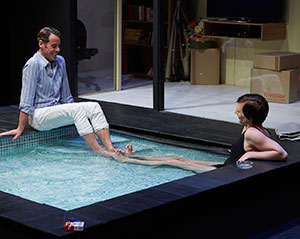
 Left – Marcus Graham and Ash Flanders. Cover – Ash Flanders and Tim Walter. Photos – Ellis Parrinder
Casting men to play women's roles is by no means new: Genet’s The Maids has often used men in the roles in order to highlight the universality of the power dynamic of the relationship. In Belvoir’s new production of Hedda Gabler, Adena Jacobs writes in her Director's Notes that she doesn't want to explain why she cast a male actor as Hedda and hopes the production will speak for itself, but I am still wondering.
Ash Flanders was absolutely wonderful in the over the top, comic spoof, Little Mercy, but there is a world of difference in playing that and tackling what is considered one of the great roles of the canon. It is not casting a male actor that is the issue with this production, it is casting an actor in a role that is beyond him.
Hedda, Miss Julie, Madam Bovary, Anna-Karenina: ever since these tragic female characters emerged in the second half of the nineteenth century, debate has raged about the degree to which they deserve our sympathy. Do they personify the stultifying, limited choices of women in their cultural milieu or are they simply selfish narcissists? The greatness of these characters is that they are both; they are complex. Not entirely likeable, but thoroughly understandable and deeply sympathetic.
Hedda Gabler is a beautiful, wealthy woman, newly married to a good but ordinary academic and she already feels trapped. Hedda craves the autonomy that is every person's right and she suffers frustrations that affect so many. But she is also a selfish narcissist. Unfortunately Flanders' Hedda lacks the nuance and complexity that is vital to this role and so his Hedda is just plain petulant and nasty. He never lets us sympathise with her. Because it is played with minimal emotional range, it becomes very tiring to watch.
Adaptor/director Jacobs also notes that when she thought of Ash Flanders she imagined "the poetry of Ibsen's play”. But the script has been stripped so fiercely, that the narrative feels trivial and none of Ibsen's poetry remains. With such a truncated version, it is all the more important to ensure that every moment moves the narrative and the themes forward. But this doesn't happen. Elements of the set (the pool, the car, the glassed in room) seem to drive the direction, but they hamper the production rather than facilitate it. Much of the staging around the pool is awkward. By the time nearly every single character has taken a dip, it is a theatrical stretch, but when the maid (Branden Christine) spends a very long time sitting on the edge of the pool before taking her clothes off for her dip, it is just gratuitous and poses the question "what does this have to do with Hedda's plight?".
But that was not my only question: why does Hedda spend the first half of the show in a swimsuit and the second half naked, but for a fur coat? And why does she take it off and stand before the audience for about a minute? And why does she occasionally pop on a wig, only to remove it straight away? We are accustomed to identifying symbolism but so much of what happens is not invested with any intent and consequently it is so difficult to read that it appears merely eccentric.
The show has a very slow, torpid tone. Over and over, the audience is left to gaze infuriatingly at an empty set. Elements that have worked so well in other productions suffocate this one. The glass room that was both a thing of beauty and a multilayered metaphor in Benedict Andrews’ production of Who's Afraid of Virginia Woolf?, just deadened the action that occurred behind it in this one. Similarly the scenes in the car were diminished by it as opposed to Simon Stone's dramatic use of the car in his superb Death of a Salesman.
Full credit to the rest of the cast who were uniformly strong, including: Marcus Graham's marvellously charming, creepy Brack, Lynette Curran's doting Aunt Julie, Oscar Redding's highly strung Lovborg, Tim Walter's good, decent Tesman and the wonderful Anna Houston as the pitiable Thea Elvsted. They all did what they could to maintain the energy and meaning of the play.
Ms Jacobs is a talented director and her skill shines through in some nicely crafted moments, but this production was ill conceived.
Belvoir presents
Hedda Gabler
adapted by Adena Jacobs from the play by Henrik Ibsen
Director Adena Jacobs
Venue: Belvoir St Theatre | Upstairs
Dates: 28 June – 3 August 2014
Tickets: $68 – $48
Bookings: 02 9699 3444 | belvoir.com.au